
You Don't Own Your Most Important Link
Every creator guards their followers and their content. Almost nobody thinks about the single link quietly doing all the work in their bio.
There is one link on the internet that works harder for you than anything else you have ever posted.
It sits in your Instagram bio, your TikTok profile, your newsletter footer, your YouTube about page. Anyone who decides they want more of you taps it. It is the hinge between attention and action. And for a lot of creators, it points to a page they do not actually own.
We guard the things that feel like assets. Follower counts get checked like a bank balance. Old posts get archived instead of deleted. But the link in the bio gets set up once, in the first excited week of taking things seriously, and then it sits untouched for years, routing your most valuable traffic through a company that can rewrite the rules whenever it likes.
The rent you forgot you signed up for
Most link-in-bio tools open the door for free, then the free tier starts to itch. The provider’s name sits at the bottom of your page. A button quietly suggests your visitors try the tool too. The clean themes, the real analytics, the custom domain, the removal of that little badge, all of it lives behind a monthly fee that renews while you sleep.
None of this is a scandal. It is a sensible business, built the way most software is built. The question worth sitting with is whose business it serves. Your link-in-bio page is prime real estate, the busiest corner you have, and you are renting it from a landlord who also runs promos in the lobby.
There is a quieter cost too. The clicks that flow through that page, and the patterns inside them, belong to the platform rather than to you. If the company gets acquired, pivots, or simply decides the free tier needs trimming, you find out the hard way. Build your whole funnel on top of someone else’s free plan and you become a sitting duck 🦆 the day the terms change.
What owning it actually gets you
Owning the page does not mean coding a website or hiring a developer. It means the page lives somewhere you control, looks the way you want, and costs nothing to keep running.
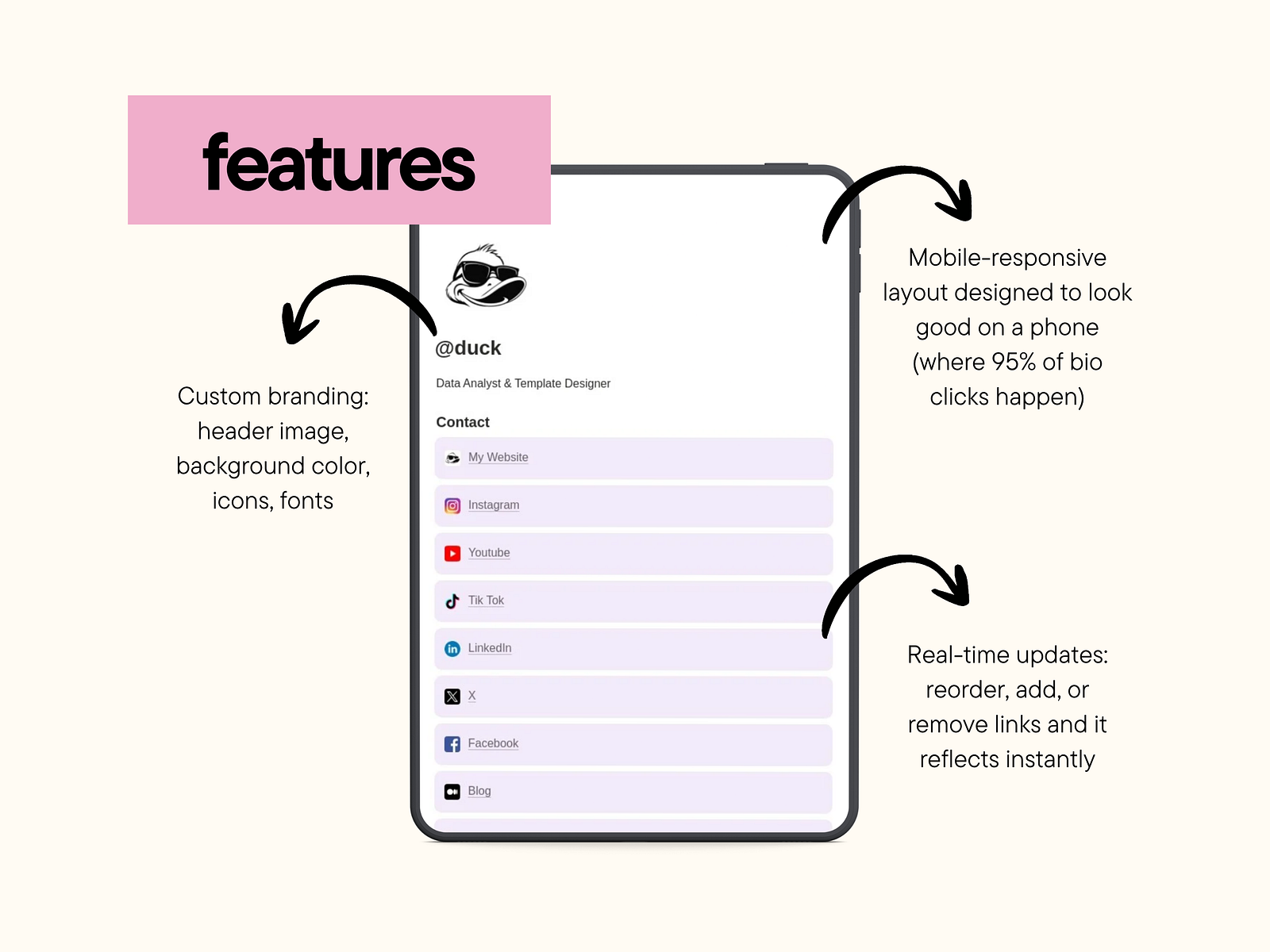
A plain Notion page does this surprisingly well. You make a page, style it, drop in your links, and flip it to public. Notion hands you a URL you can paste into any bio. When you launch something new, you edit the page and every visitor sees the change instantly. No publish queue, no plugin, no upgrade prompt.
The practical wins stack up fast:
- One URL to share everywhere, updated in real time
- Unlimited links, with no “upgrade for more” wall
- Your header, your colors, your layout, and nobody else’s badge at the bottom
It reads cleanly on a phone, which is where almost every tap comes from. And because it is just a Notion page, rearranging it when a campaign ends or a new product drops takes about thirty seconds. Get your ducks 🦆 in a row once and the upkeep becomes an afterthought.
The afternoon version
You can build this from scratch. Open Notion, make a page, add buttons or callouts for each link, choose a cover, and toggle sharing on. An hour of fiddling and you have a working link hub.
The reason a lot of creators never get around to it is the same reason the rented page survives for years. It is one of those small jobs that never reaches the top of the list. It is easy to duck 🦆 out of, because the current setup mostly works, and “mostly works” tends to win out over “actually mine.”
That gap is exactly why a starting point helps. A pre-built, mobile-tuned page removes the blank-canvas friction, so the job shrinks from an afternoon project to a ten-minute swap of placeholder text for your own.
Why this matters more every year
Platforms come and go. The link that connects your audience to whatever you are building should outlast all of them. As more of a creator’s income runs through a single tap, handing that tap to a third party on a free plan looks less like convenience and more like a quiet risk you forgot you were carrying.
Owning the page is not a growth hack. It is closer to insurance, the cheap and boring kind you are glad you bought the day something changes.
If you would rather skip the blank page, I built a Notion Link in Bio template that gives you a clean, mobile-ready hub out of the box. Duplicate it, swap in your links and branding, make it public, and paste the URL into every profile you have. No subscription, no badge, no landlord.
Set it up once, then forget about it, knowing the most important link you have finally points somewhere you own.